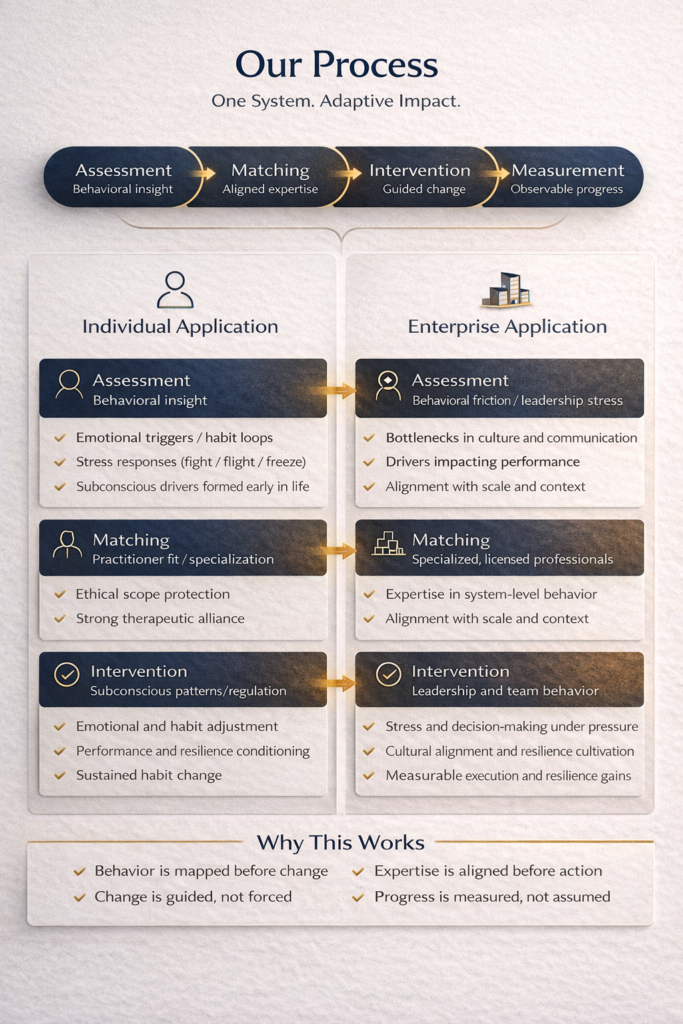
[Assessment] → [Matching] → [Intervention] → [Measurement]
The QuinSentia Process
This flow should be represented visually as a horizontal or circular system diagram, with
subtle branching below each step for Individual and Enterprise use cases.
1. Assessment
Behavioral insight before behavioral change
Subconscious behavioral patterns are mapped using structured, non-diagnostic tools. This
reveals how behavior is automated, reinforced, and expressed under pressure.
Individual Application
- Identifies emotional triggers and habit loops
- Clarifies stress responses (fight / flight / freeze)
- Surfaces subconscious drivers formed early in life
Enterprise Application
- Identifies systemic stress patterns
- Reveals leadership and communication bottlenecks
- Maps behavioral friction impacting performance and culture
Why this works
Behavior cannot be changed reliably until it is understood. Mapping patterns removes
guesswork and replaces assumptions with clarity—without labeling or pathologizing.
2. Matching
The right expertise for the right profile
Clients are matched with licensed or credentialed professionals whose scope, expertise, and
approach align with the identified behavioral profile and goals.
Individual Application
- Alignment with practitioner specialization
- Ethical scope protection
- Stronger therapeutic alliance
Enterprise Application
- Matching organizations with professionals skilled in leadership, stress systems, and performance behavior
- Ensures interventions align with organizational context and scale
Why this works
Outcomes improve dramatically when fit is intentional. Proper matching increases engagement,
reduces dropout, and respects professional boundaries.
3. Intervention
Guided change within ethical frameworks
Professionals guide change using ethical, evidence-informed methods appropriate to their
training and scope.
Individual Application
- Subconscious pattern modification
- Emotional regulation and habit restructuring
- Performance conditioning and resilience building
Enterprise Application
- Leadership and team behavior optimization
- Stress and decision-making under pressure
- Cultural alignment through behavioral intelligence
Why this works
Change is most durable when guided—not forced—and when methods align with both the
nervous system and real-world demands.
4. Measurement
Progress that can be seen and adjusted
Behavioral change is tracked over time to support clarity, accountability, and refinement.
Individual Application
- Improved emotional regulation
- Better sleep, focus, and consistency
- Sustained habit change
Enterprise Application
- Reduced friction and burnout signals
- Improved engagement and execution
- Measurable performance and resilience gains
Why this works
What gets measured can be refined. Measurement turns transformation into an observable
process, not a vague promise.
Why QuinSentia’s Process Works
Most systems fail because they:
- Start with solutions instead of understanding
- Treat behavior as willpower-based
- Ignore the subconscious and nervous system
- Lack ethical alignment and follow-through
QuinSentia works because it:
- Addresses behavior at the level it is formed
- Separates insight from diagnosis
- Aligns expertise before intervention
- Measures change to sustain it
This creates predictable, scalable outcomes—for individuals seeking personal change and
organizations seeking systemic performance improvement.
The Result
One process. Many applications.
- Individuals gain agency and regulation
- Professionals deliver higher-quality outcomes
- Organizations gain behavioral intelligence at scale
QuinSentia doesn’t guess at change.
It engineers it—ethically, measurably, and adaptively.